

There's no such thing as intact flesh
Word of the week: Sarg
Wiktionary can’t be trusted—you know that, right?—and any statement I may have made to the contrary was, as the kids today1 say, sarc.
But it can be a useful starting point, as with today’s word, Sarg.
If you have been following my posts about Murnau’s Nosferatu, you’ve seen this word lately. It appears there repeatedly in its plural form:
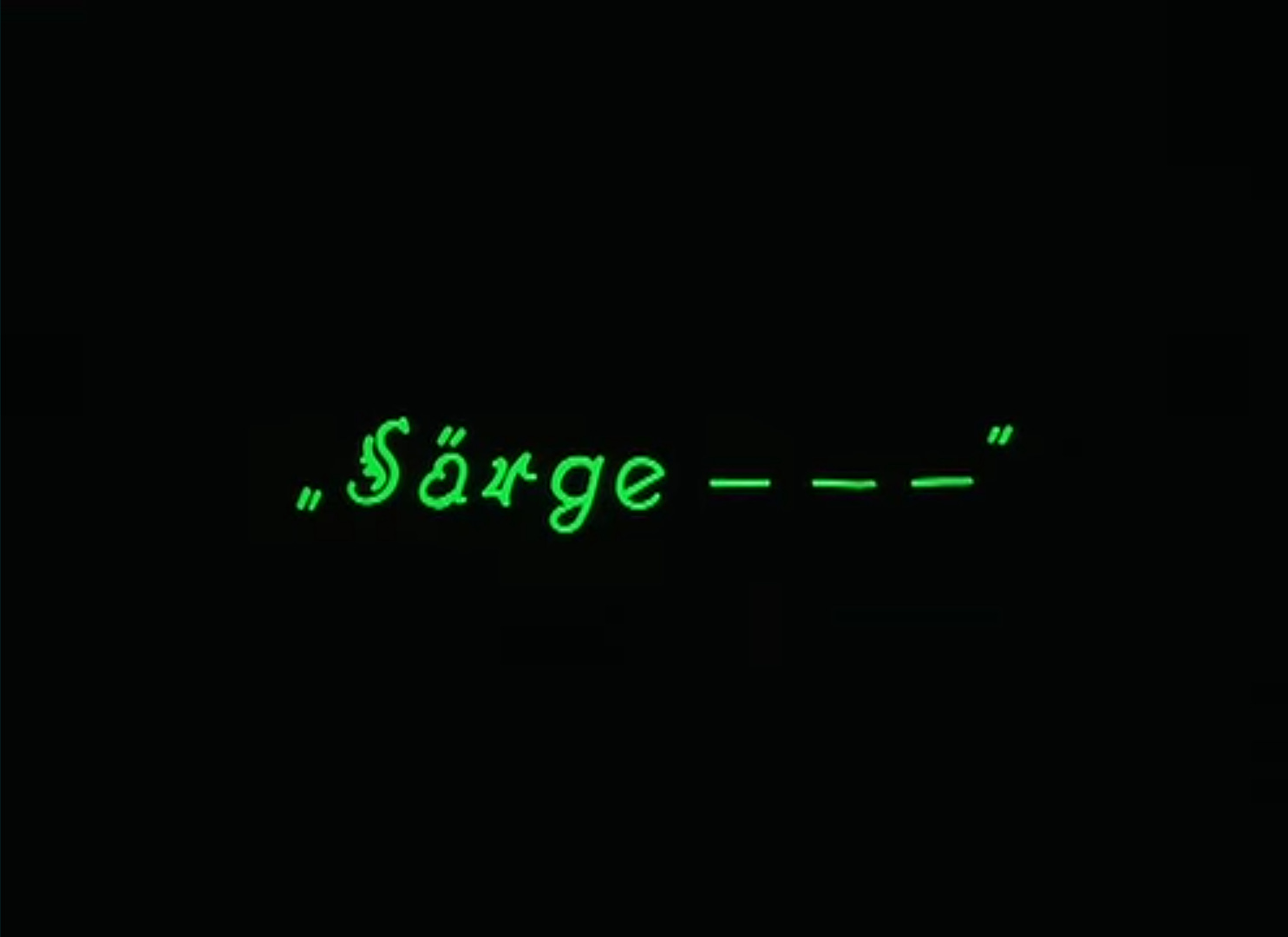
English Wiktionary tells us that Sarg is “[f]rom Middle High German sarc, from Old High German sark, sarh, from Proto-West Germanic *sark (‘grave, coffin’).”
This is true as far as it goes, but it leaves out the interesting part. Sark sounds suspiciously like sarcophagus, but sarcophagus is a latinized Greek word, and *sark is a Germanic root. So is it all just a coincidence?
There are coincidences in etymology, but this isn’t one of them. One click away from that Wiktionary entry, you’ll find that *sark was, in fact, borrowed from Latin, and it does trace back to Greek σαρκοφάγος.
Both English sarcophagus and German Sarkophag (a doublet of Sarg)2 refer to a stone coffin—or, more often in current use, to the stone box that surrounds a mummy case or to the wooden case itself.
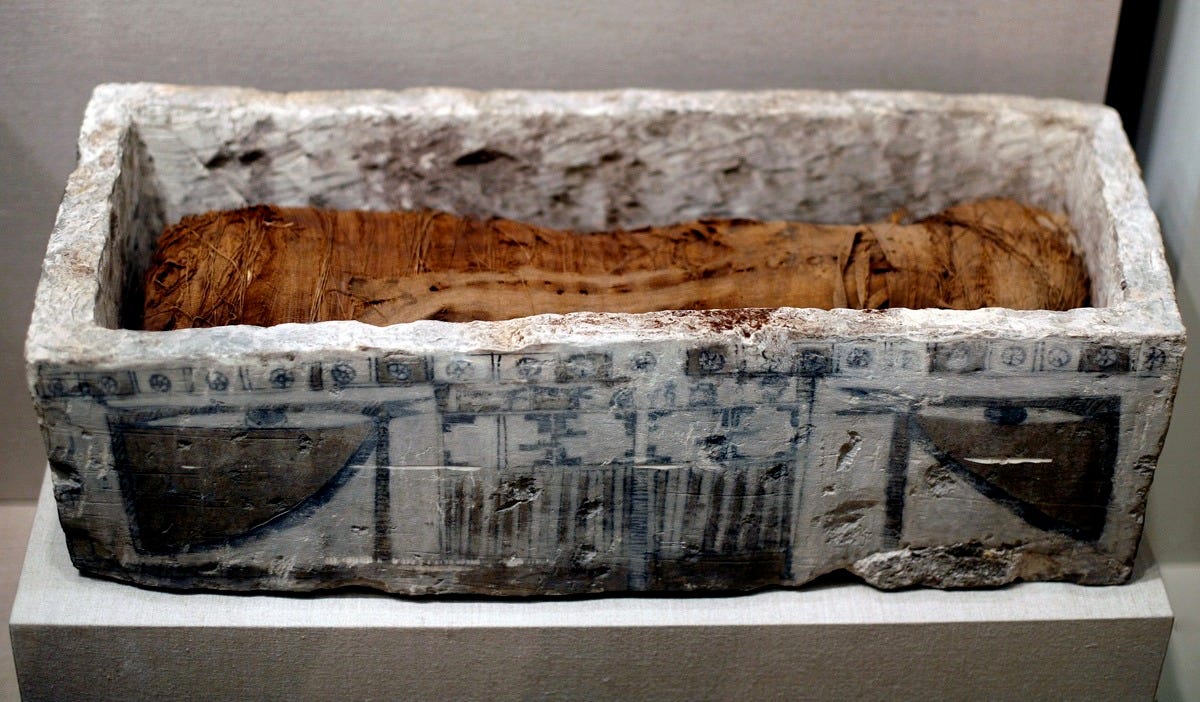
So the modern word has a powerful sense of—well, preservation. But it is destructive in its origins.
See, the Greek roots behind sarcophagus are words meaning “flesh” and “eat.” The term originally referred to a type of stone that was used to make coffins because it was believed to speed the decomposition of the remains within.
If you have ever spent time reading old whodunits of the gruesomer sort, you’re probably shouting “Quicklime!” right now—and yes, that’s the stuff.3 The German word for it is Ätzkalk—derived from Kalk (cognate with English chalk) and ätzen (cognate with English etch, and suggestive of its corrosiveness).
The sarc- in sarcophagus, by the way, is also the sarc- in sarcasm, which in the depths of its Greek origin suggests teeth gnashing at flesh.
German Sarkasmus is a superior word: its phonetic chewiness comports well with its origins, and the Latinate -us ending gives it a fierce dignity and a sense of constrained violence that the snide and petering English sarcasm cannot match.
By which I mean a bit over a century ago. (The OED does have a later citation—from 1926.)
Sarkophag was borrowed into German in the mid-18th century. English sarcophagus in the sense “stone coffin” dates to 1705.
Although it may not serve this purpose as well as novelists and murderers seem to think: a study using pig cadavers determined that lime retards decomposition.
Sara- I never thought I’d be reading about “phonetic chewiness” today. So I love discovering your piece. Especially if it takes me across a journey of etymology. Great essay.